YouTube Is the New Television: Why Companies Still Underestimate the Platform
When companies talk about social media, the same platforms usually dominate the discussion: Instagram, Facebook, LinkedIn, and TikTok. YouTube, on the other hand, is often treated as an additional channel: important, but rarely at the strategic center.
Yet much currently suggests that this is exactly where one of the most important developments in digital marketing is taking place.
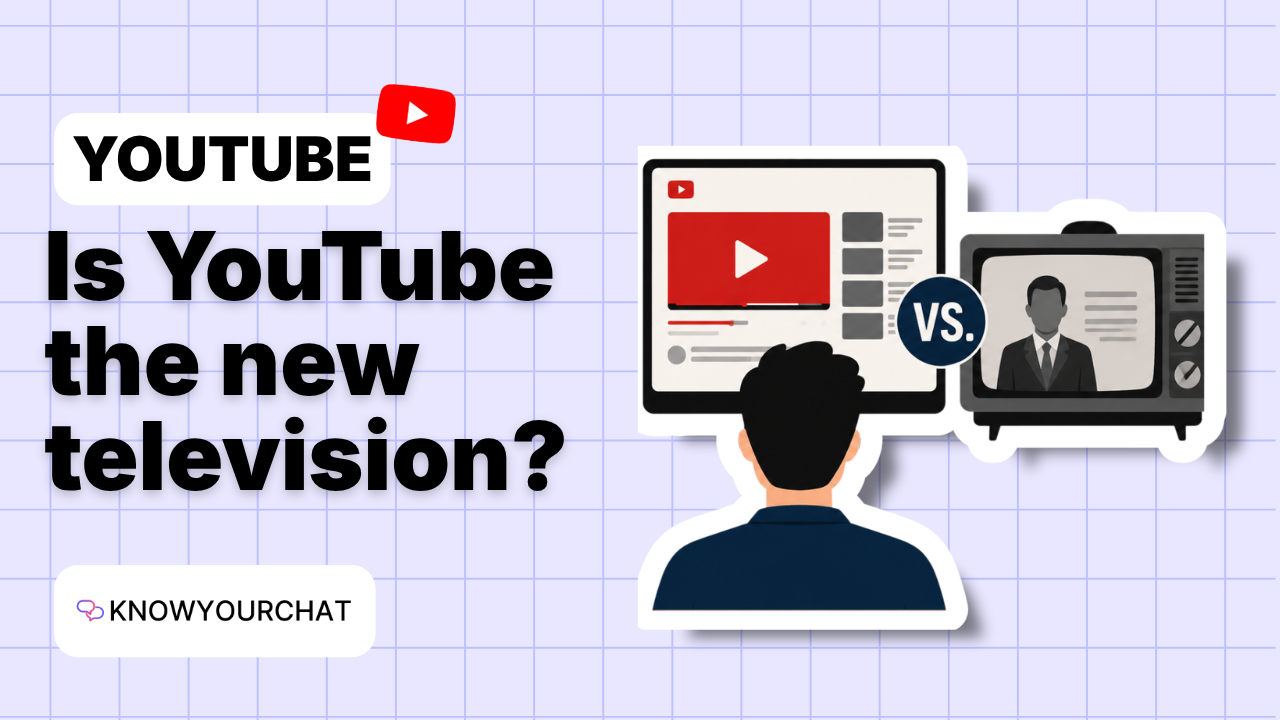
YouTube has now overtaken Netflix in several markets in average daily viewing time. According to recent surveys, users worldwide spend an average of around 99 minutes per day on the platform. At the same time, according to Nielsen, YouTube is now the most-watched streaming platform on TV sets in the US, reaching a larger share of TV usage there than Netflix. On top of that, over one billion hours of YouTube content are now consumed on televisions every day.
These numbers do not simply show the growth of a platform. They show a fundamental shift in media consumption.
YouTube has long been more than social media
Many companies still see YouTube as a video platform. In reality, however, the platform is increasingly evolving into a mix of search engine, streaming service, education platform, and social network. It is exactly this combination that makes YouTube so interesting.
The digital world used to be comparatively clearly structured. Television was entertainment. Google was search. Social media was communication.
Today, these boundaries are increasingly blurring. People inform themselves on TikTok. They debate on LinkedIn. They consume news via Instagram. And they spend hours on YouTube to learn, be entertained, or solve concrete problems. YouTube benefits particularly strongly from this development because the platform satisfies several needs at once.
Someone scrolling through Instagram is often looking for entertainment or inspiration. Someone going to YouTube often arrives with a concrete intent. Users want to learn something. They want to prepare a purchase decision. They want to understand how a product works. They want to listen to experts.
That is exactly why attention on YouTube differs fundamentally from many other platforms.
The underrated search engine
While companies invest a lot of time in classic search engine optimization, another area is often overlooked: video search.
YouTube has been considered the world's second-largest search engine for years. Millions of people search there every day for tutorials, product reviews, first-hand experiences, market analyses, or expert opinions.
The decisive difference compared to many social networks lies in the lifespan of the content. A LinkedIn post achieves most of its reach within a few days. An Instagram Reel often disappears from active attention after just a few hours. A good YouTube video, on the other hand, can still be found years later.
This changes the economics of content considerably. Every published piece becomes not just a means of communication, but a long-term digital asset.
For companies, this means: visibility no longer comes exclusively from Google. It increasingly emerges where people actively search for answers. And more and more often, that is YouTube.
Why creators are suddenly competing with Hollywood
Just a few years ago, the idea that individual creators could compete with classic film studios would have been absurd. Today, that is exactly what is happening.
Films like "The Backrooms" or "Obsession", produced by YouTube creators, recently achieved remarkable box office success. Industry media like Variety or The Hollywood Reporter now regularly report on how creators are challenging the traditional entertainment industry.
Even more interesting, however, is the actual development behind it. The most successful creators have long since ceased to be individuals. They operate like media companies. They develop formats. They build audiences. They monetize reach. They produce content for multiple platforms simultaneously. And therein lies an important lesson for companies.
The future does not belong to the companies that publish as many individual posts as possible. The future belongs to the companies that build their own media structures.
Why companies need to rethink their content strategy
Many marketing departments still work platform by platform. A post is created for LinkedIn. A Reel is produced for Instagram. Another post is made for Facebook. And then there is no time left for YouTube.
This approach is working less and less well. Not because the individual platforms are becoming unimportant. But because the number of relevant platforms keeps growing.
Anyone who serves every platform separately inevitably creates more effort. The most successful companies therefore take a different approach. They do not start with the platform. They start with the idea.
An expert interview is recorded. A webinar is held. A customer conversation is documented. From this content, various formats then emerge:
An in-depth YouTube video. Several Shorts. LinkedIn posts. Instagram Reels. Blog articles. Newsletter content. Production happens once. The value is created many times over.
That is exactly why YouTube is currently gaining importance. The platform is an excellent starting point for high-quality content that can then be distributed across many other channels.
Why personal brands are becoming ever more important
Another development further reinforces this trend. People increasingly follow people rather than companies. This has been observable on LinkedIn for years. Posts by CEOs, founders, or employees often achieve significantly more reach than company pages.
A similar effect can be seen on YouTube. There, people do not spend a few seconds with a post. They sometimes spend twenty or thirty minutes with a person. This creates a relationship of trust that classic corporate communication can hardly achieve.
That is exactly why topics like social CEOs and employee generated content keep gaining importance. A CEO who regularly talks about developments in their industry becomes a brand. A head of sales who explains customer problems becomes an expert. An employee who gives insights into their daily work becomes a credible ambassador for the company.
Video amplifies this effect even further. People do not just listen. They see facial expressions, body language, and personality. Trust develops much faster as a result.
The real challenge is not production
Many companies believe that creating content is their biggest challenge. In fact, the real complexity often only begins afterwards. The more platforms are served, the more difficult the organization becomes.
Content has to be planned. Posts have to be coordinated. Approvals have to happen. Different formats have to be taken into account. At the same time, content should stay consistent and fit the brand.
The result: many companies do produce content, but only partially tap its potential. Not because the content is bad. But because the processes behind it are missing.
Why content systems are the future
This is exactly why the focus in marketing is currently shifting. The question is no longer: "How do we produce more content?" The more interesting question is: "How do we use existing content more intelligently?"
Companies today do not need isolated posts. They need systems. Systems that organize content. Systems that develop ideas further. Systems that connect different platforms with each other.
The more channels emerge, the more important this approach becomes. Because attention is becoming scarcer. Time is becoming scarcer. And at the same time, expectations of professional communication are rising.
How KNOWYOURCHAT supports companies with this
This is exactly where KNOWYOURCHAT comes in. Because the challenge of modern communication has long since stopped being solely about creating content.
The real challenge is making content usable across platforms. A YouTube video should not remain just a video. It can become the starting point for LinkedIn posts, Reels, Shorts, blog articles, or newsletters.
With KNOWYOURCHAT, these processes can be organized centrally. Teams keep an overview of content, approvals, and publications. The AI Crew helps derive new formats from existing content and develop content further for different platforms.
As a result, a single idea no longer turns into a single post. It turns into a content system that works in the long term.
Conclusion
YouTube today is far more than a video platform. The development of recent years shows that the boundaries between social media, search engines, streaming, and classic media are increasingly disappearing.
For companies, this leads to an important insight: the question is no longer whether YouTube is relevant. The real question is how content will be organized in the future.
Those who keep producing for individual platforms will permanently have more effort. Those who instead start to understand content as part of a connected system can achieve significantly more reach, visibility, and impact with the same idea.
YouTube is therefore not just another channel. The platform already shows today what the future of content marketing looks like.