Meta and Muse Image: Why the Backlash was inevitable

You post a photo on Instagram.
Maybe it's from your last vacation. Maybe it's a picture of your dog. Or perhaps it's a special moment shared with friends or family. You decide which photo to upload, what caption to write, and whether your profile should be public or private.
You already know that people can view your public posts. That's exactly why you publish them.
But imagine finding out months later that other users can use those very photos as the foundation for entirely new AI-generated images.
Suddenly, something feels different. Not because your photos have been stolen. Not because your account has been hacked. But because the purpose of your content has changed.
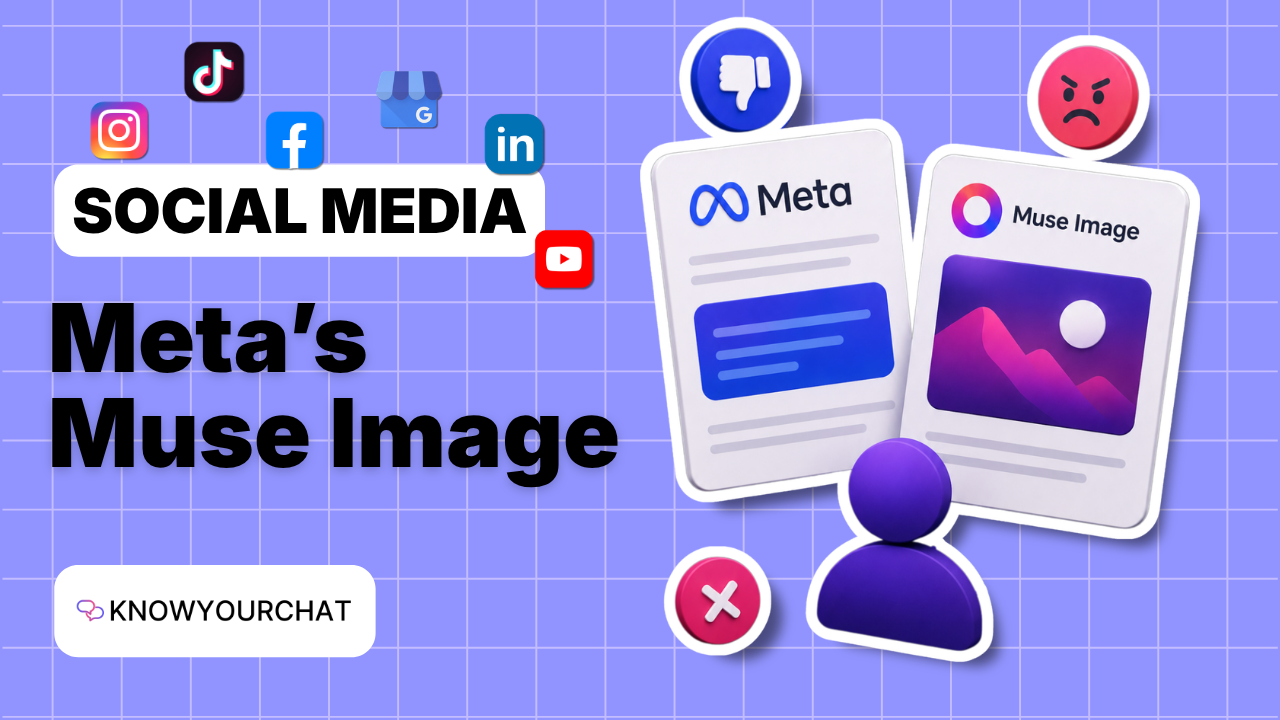
That's exactly what the current debate surrounding Meta and its new AI image model, Muse Image, is really about.
And that's also why it's worth looking beyond the headline. In our view, this discussion isn't primarily about another AI image generator. It's about trust.
Muse Image Is Technologically Impressive
Let's start with the technology itself.
With Muse Image, Meta has introduced one of its most advanced image-generation models to date. Together with its companion model, Muse Spark, the company is introducing what it calls Agentic Image Generation. In simple terms, the AI doesn't just create images from a prompt—it also refines and improves its own results automatically in the background. According to Meta, this leads to higher-quality images while making the overall experience easier for users.
Outside the company, Muse Image is also being recognised as a highly competitive model. Early benchmarks place it among today's leading AI image generators. At the same time, Meta has announced plans to gradually integrate Muse Image into Meta AI as well as products such as Instagram, WhatsApp and, eventually, advertising solutions like Advantage+.
Taken together, these announcements make one thing clear: Meta isn't simply launching another AI tool. The company is systematically transforming its entire ecosystem around artificial intelligence. So far, this looks like a typical product announcement. But that's exactly where the real story begins.
The Criticism Was Never Really About the AI
Alongside the launch of Muse Image, Meta also introduced a new Instagram feature.
Users could mention public Instagram profiles and generate entirely new AI-created images based on the photos published on those accounts. Only public profiles were affected. Anyone who didn't want their content to be used in this way could disable the feature within Instagram's settings. Meta chose an opt-out approach rather than asking users for explicit permission beforehand.
At first glance, it seemed like a relatively small addition.
Within days, however, it became the main topic of discussion.
What's particularly interesting is what people were actually criticising.
Very few questioned the quality of Muse Image.
Very few criticised the AI-generated images themselves.
Instead, the conversation focused on something entirely different.
Many users felt that the purpose of their content had changed.
They had chosen to make their photos public so that other people could view, like and comment on them.
Not necessarily so they could become the starting point for entirely new AI-generated images.
That distinction is crucial.
Why It Feels Wrong to So Many People
From a legal perspective, many aspects of this debate can be discussed.
From a psychological perspective, however, the issue becomes even more interesting.
People make decisions within a particular context.
If you give a restaurant your phone number, you expect a reservation confirmation—not marketing messages about next week's menu.
If you provide your email address when shopping online, you expect an order confirmation—not necessarily a daily newsletter.
The same principle applies to social media.
People publish content publicly because they expect others to view it, like it or comment on it.
They don't automatically expect those same images to become the basis for AI-generated content.
That's where the real tension emerges.
Not between privacy and artificial intelligence.
But between expectation and actual use.
Researchers even have a term for this concept: Contextual Integrity.
The idea is that information shouldn't simply be protected—it should also continue to be used within the context in which people originally shared it.
Applied to Muse Image, that means the following:
For many users, the problem isn't that their photos are public.
The problem is what those photos can suddenly be used for.
Meta Responded Surprisingly Quickly
What makes this case even more remarkable is how quickly Meta reacted.
Just days after the feature was introduced, the company publicly admitted that it had "missed the mark." The option to generate AI images based on public Instagram photos via @mentions was removed almost immediately.
That isn't something we see very often from Meta.
What's even more interesting is why the company reversed course.
It wasn't because Muse Image failed to deliver.
The model itself performed exactly as intended.
The controversy emerged somewhere else entirely.
According to Instagram's official Help Center, only public profiles belonging to adult users were affected. Private accounts and minors were excluded, and anyone who didn't want their content to be used in this way could disable the feature at any time through Instagram's settings.
Yet many users still felt uncomfortable.
Why?
Because transparency is about more than simply offering a setting.
True transparency means people understand that a setting exists, why it matters and what the consequences are if they leave it unchanged.
That's the difference between a technically correct solution and one that people genuinely accept.
Trust Doesn't Come from Technology
The Muse Image story reveals something that goes far beyond Instagram.
For years, artificial intelligence has largely been judged by one criterion: performance.
Which model writes better text?
Which one generates more realistic images?
Which one produces videos faster?
Those questions still matter.
But they are no longer the only ones.
With every new AI innovation, another question becomes increasingly important:
Do people trust this technology?
Or perhaps more accurately:
Do they trust the company behind it?
That distinction matters.
People aren't rejecting artificial intelligence itself.
Millions of users rely on ChatGPT, Midjourney, Gemini and Meta AI every single day.
Most users didn't object to Muse Image because it was an AI image generator.
They objected because the purpose of their content had changed without them consciously agreeing to that change.
In our view, that's the real lesson.
What We Can Learn from This
Perhaps we're witnessing a turning point.
For years, the central question surrounding AI was simple:
What is artificial intelligence capable of?
Today, a second question is becoming just as important:
What do people expect from the responsible use of AI?
This isn't a challenge that concerns Meta alone.
It affects every organisation integrating artificial intelligence into its communication.
Not because AI is inherently problematic.
But because every new technology creates new expectations.
People want to understand how content is created.
They want to know how their data is being used.
And above all, they want to feel that they remain in control.
That is why trust is rapidly becoming one of the most valuable assets in digital communication.
Content can now be generated in seconds.
Trust cannot.
It has to be earned.
Great AI Doesn't Start with a Prompt
Perhaps that's the most important lesson from Muse Image.
The future won't be decided by which company has access to the most powerful AI model.
It will be decided by how thoughtfully organisations integrate artificial intelligence into their communication.
Even the best AI knows nothing about a company's identity, values, audience or long-term communication goals—unless it's given that context.
It can generate content.
It cannot define purpose.
That's why great communication doesn't begin with a prompt.
It begins with strategy.
With understanding what matters to your audience.
With knowing how your brand should sound.
With identifying the questions people are actually asking.
And with creating content that builds trust over time.
How KNOWYOURCHAT Helps
This is exactly where KNOWYOURCHAT comes in.
Rather than helping businesses produce as much content as possible, the AI Crew is designed to help them create the right content.
Because it understands a company's preferred tone of voice and considers current market developments as well as competitive insights, ideas are developed strategically rather than randomly.
Users can ask the AI Crew which topics currently matter most to their audience, which questions are being asked most frequently or which content ideas best support specific communication goals.
Based on these insights, the AI Crew develops compelling hooks, captions and video scripts tailored to both the brand and the platform.
In addition, KNOWYOURCHAT's Insights help businesses track the performance of their published content over customised time periods, making it easier to identify successful topics and continuously refine future content strategies.
Looking to integrate AI into your communication strategy without losing your brand identity? Register for KNOWYOURCHAT for free and discover how our AI Crew helps you identify relevant topics and turn them into content that truly reflects your business.
Conclusion
Muse Image is about far more than just another AI image generator.
The story highlights how the conversation around artificial intelligence is evolving.
Not every technically possible feature will automatically be accepted.
People want to understand how new technologies work, how they affect their content and where they still have control over the decisions that matter.
That's why the real competitive advantage in the age of AI is unlikely to be determined by technology alone.
It will belong to those organisations that successfully combine innovation with transparency and trust.
Perhaps that's the most important lesson Muse Image has to offer.
In the long run, the winning AI won't simply be the most powerful one. It will be the one people trust.