Why AI Is increasing the value of real people

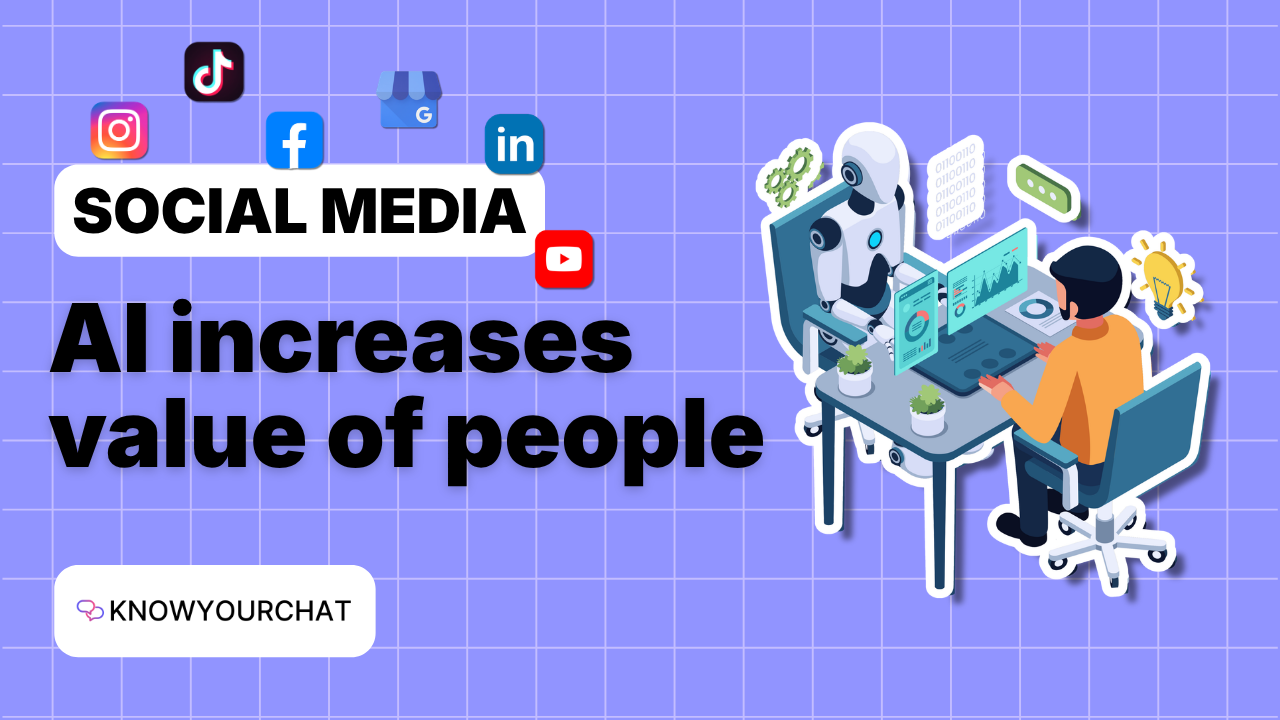
When ChatGPT became widely available at the end of 2022, much of the discussion revolved around a single question: What tasks will artificial intelligence take over in the future?
Since then, the technology has evolved at an astonishing pace. AI can write articles, generate images, produce videos, analyze data, and support businesses in areas that once required highly specialized professionals. Many of the predictions made back then have already become reality.
At the same time, another development has emerged—one that receives far less attention. The more capable AI becomes, the more valuable uniquely human qualities appear to be. Experience. Personality. Credibility. Trust.
At first glance, that may seem contradictory. Yet the effect is already visible across countless industries, particularly in marketing, corporate communications, and social media.
Content is becoming a commodity
Not long ago, producing content required a significant investment of time and resources. Blog articles had to be researched and written. Social media posts often went through multiple rounds of review. Creating images or videos frequently involved external agencies or specialized professionals. Today, the situation looks very different.
With just a few prompts, businesses can generate articles, visuals, and even video concepts within minutes. The barrier to content creation has dropped dramatically. For companies, that is largely positive. However, it also changes the way content is perceived.
When high-quality content is available at any moment, its mere existence becomes less meaningful. Audience attention remains limited while the volume of published content continues to grow. As a result, the question is shifting. Instead of asking, “Can we create content?”, businesses increasingly need to ask: “Why should anyone pay attention to our content in particular?”
Information alone is no longer enough
A quick look at LinkedIn illustrates this trend. Every day, thousands of posts are published about leadership, sales, marketing, recruitment, and artificial intelligence. Many are accurate. Many are well written. Yet most disappear from people’s attention almost immediately.
The issue is rarely the quality of the information itself. More often, what’s missing is perspective. People are interested in more than facts. They want to know what someone experienced, which challenges they faced, and what lessons they learned along the way.
The same information becomes far more engaging when it is combined with a personal point of view. That is why personal experience is becoming increasingly valuable. It cannot be copied. It cannot be automated. And it cannot be reproduced at scale.
Guidance matters more than information
For decades, access to information was a competitive advantage. Those who possessed knowledge could differentiate themselves from others. Today, we live in a very different reality.
Information is available almost everywhere. Tools like ChatGPT, Claude, Gemini, and Perplexity can provide expert-level information within seconds. As a result, expectations are changing. People are no longer looking exclusively for answers. They are looking for guidance. How does an expert interpret a particular development? How does a CEO assess changes in the market? What lessons has a company learned from a specific strategy?
Questions like these are becoming increasingly important. Information is abundant. Interpretation and guidance remain scarce.
Why people follow people
This shift can be observed across virtually every platform. People are drawn to people. They follow founders, executives, specialists, and employees. They pay attention to their opinions, experiences, and perspectives. That does not mean corporate brands are losing relevance. Rather, trust is often built through the individuals behind those brands.
A CEO can explain why a certain decision was made. An employee can provide behind-the-scenes insights into a project. An expert can make complex topics easier to understand. Together, these interactions create a sense of familiarity that traditional corporate communication often struggles to achieve.
When people consistently share meaningful insights, they become more relatable and accessible to their audience. That accessibility plays a far greater role in purchasing decisions than many organizations realize.
The rise of the Social CEO
Nowhere is this trend more visible than on LinkedIn. More and more executives are actively using the platform to share their experiences and comment on developments within their industries. The goal is no longer simply reach. Personal visibility builds trust.
Executives who regularly discuss decisions, challenges, and market developments become associated with specific topics and areas of expertise. Over time, they build a reputation that extends far beyond traditional corporate communication.
Many companies are discovering that posts from leadership teams often generate significantly more engagement than content published through corporate channels.
That should not come as a surprise. People connect with stories, experiences, and perspectives. Those elements tend to appear far more naturally in personal content than in traditional corporate announcements.
Why Employee Generated Content is thriving
A similar dynamic is driving the rise of Employee Generated Content. More organizations are recognizing that their employees possess experiences that others genuinely want to hear about.
An apprentice shares insights into daily training. A project manager talks about challenges within a client engagement. A developer explains how a product was built. Content like this often feels more authentic and approachable than traditional corporate messaging.
The reason is simple. It is rooted in real-world experience. While AI can generate text, the experiences themselves are still created through everyday work, customer interactions, projects, and collaboration. That is where some of the most compelling stories originate. And often, the most credible ones as well.
Why human oversight is becoming more important
Every new generation of AI models expands what the technology can do. The writing improves. Images become more realistic. Analysis becomes more sophisticated. Yet one thing remains unchanged: AI does not take responsibility.
It can identify patterns, combine information, and suggest solutions. Whether those suggestions are appropriate, accurate, or aligned with a specific situation still requires human judgment. This is evident in businesses every day.
AI can draft a LinkedIn post. It cannot determine whether the message reflects a company’s culture, reveals sensitive information, or resonates with the intended audience.
The same principle applies to marketing strategies, customer communication, and business decisions. The quality of an outcome depends not only on what AI produces, but also on who evaluates, challenges, and refines those outputs.
As a result, expertise remains important while judgment, experience, and contextual understanding become increasingly valuable. People are becoming curators and decision-makers, selecting the right direction from an ever-growing number of possibilities.
The irony of the AI Era
As AI becomes more powerful, access to information and content becomes easier. Articles can be generated faster. Images can be created faster. Videos can be produced faster. This changes the value equation.
Content production itself becomes less exclusive. Personality, experience, and credibility become more important. We can already see this shift taking place.
Organizations are investing more heavily in personal branding, Social CEOs, and Employee Generated Content—not because these are passing trends, but because they build trust. And trust remains a scarce resource, even in a world shaped by AI.
What this means for businesses
Many companies are currently exploring how to integrate artificial intelligence into their operations. A more useful question may be: How can we make the people within our organization more visible?
Every company has experts, leaders, and employees with valuable knowledge and experience. What is often missing is a structure that helps make that expertise visible. The content that will remain relevant in the years ahead is already there. Its value comes from the experiences, observations, and insights behind it.
How companies can put this into practice
Most organizations understand that they need to become more visible. The challenge lies in execution. Which topics should they focus on? Which platforms matter most? Who should take on the role of a Social CEO? How can employees contribute effectively? And how do these efforts become part of a long-term strategy?
This is where workshops and strategic planning become valuable. By working closely with companies, it becomes possible to identify the people, topics, and opportunities that can support sustainable visibility and long-term brand growth.
In many cases, the most compelling content already exists. It lives within projects, customer conversations, employee expertise, and everyday experiences. The challenge is not finding new stories. It is uncovering and sharing the stories that already exist.
How KNOWYOURCHAT supports this process
As more people begin contributing to communication efforts, complexity naturally increases. Ideas need to be collected. Topics need to be planned. Content requires approval. Different platforms demand different formats. At the same time, communication must remain consistent without losing its personal character.
This is where KNOWYOURCHAT and the AI Crew come in. Rather than creating content in isolation from a single prompt, the AI Crew works with a company’s knowledge, objectives, brand voice, and communication style. The result is content that feels significantly closer to the way the organization actually communicates.
While general-purpose language models often start from scratch with every new request, the AI Crew builds on existing context, taking target audiences, content pillars, brand values, and linguistic nuances into account. This becomes especially valuable when supporting Social CEOs and Employee Generated Content initiatives.
Personal experiences and individual perspectives remain human. The AI Crew helps shape those experiences into content that reflects both the individual and the company behind them. The outcome is not generic AI-generated content. It is communication that creates recognition, consistency, and long-term brand value.
Conclusion
Artificial intelligence is changing the way content is created. Content production is becoming faster, more affordable, and more accessible than ever before. As a result, the factors that capture attention are changing as well. Personal experience, authentic perspectives, and credible communication are becoming increasingly valuable.
Organizations that make their employees, experts, and leaders visible create something that cannot easily be automated: Trust. And in the years ahead, trust may become one of the most valuable assets in digital marketing.