How to Consistently Find Good Content Ideas
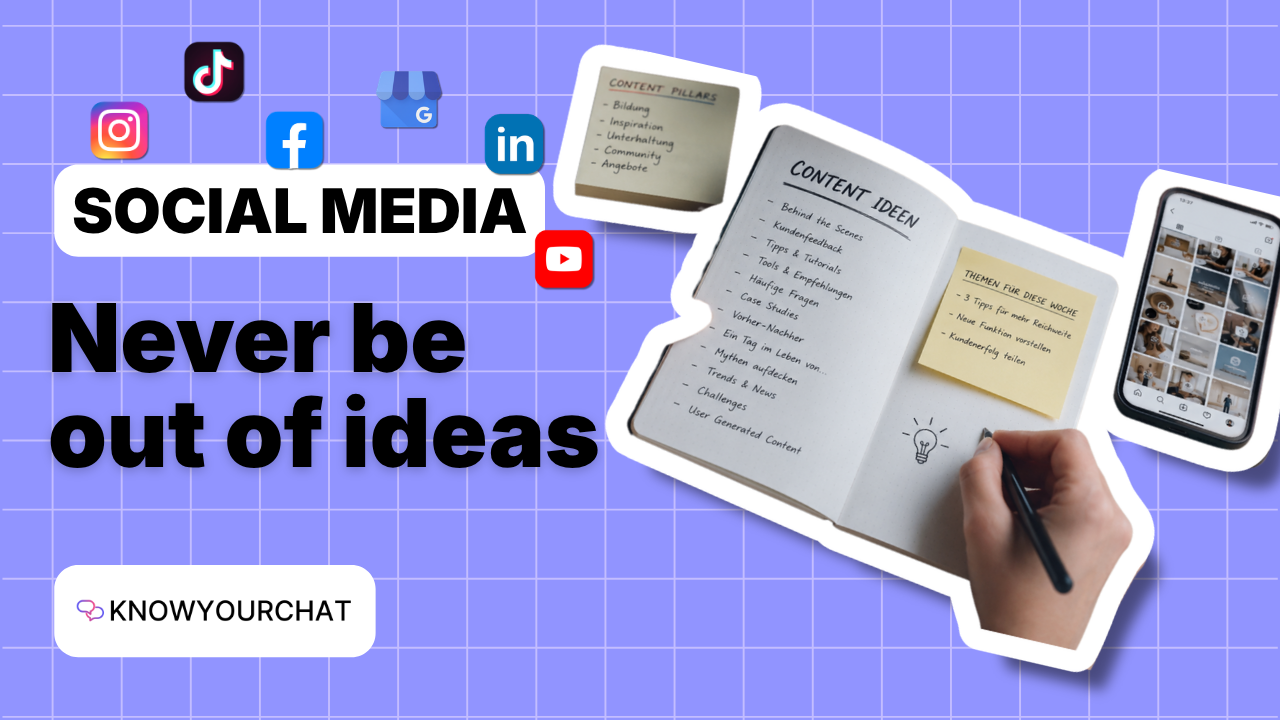
One of the most common challenges in everyday social media work isn't the execution, but the moment before it. The question of what to actually post about keeps coming up – regardless of how much experience you already have.
Many people assume they simply lack ideas. In practice, however, a different picture emerges. Ideas often exist, but they aren't recognized as such or aren't consistently developed further. This creates the feeling of constantly having to start from scratch.
This is exactly where the real bottleneck lies.
Why content ideas seem to "run out"
The feeling of having run out of ideas rarely stems from an actual shortage. It arises because ideas are often viewed in isolation. A thought is used once, executed, and then discarded, instead of being developed further or viewed from different perspectives.
This turns every post into a standalone project. With each new post, the process starts over, with no connection to previous content. Inevitably, ideas feel "used up" faster than they actually are.
In reality, the potential lies not in ever-new topics, but in the depth of existing ones.
Good content strategies think in topics, not in posts
Successful social media accounts don't stand out because they constantly have new ideas, but because they consistently think existing topics forward. A topic isn't covered once and then closed; it's examined from different perspectives, deepened, and expanded.
A single thought can produce multiple pieces of content this way. One post explains a problem, another shows a solution, a third provides a concrete example, and a fourth picks up typical mistakes. The idea stays the same, but the execution changes.
This not only creates more content, but also a clear connection between posts – which is decisive for growth.
The biggest mistake: not developing ideas further
In many teams, ideas are collected but not used systematically. They sit in notes, documents, or tools, but are rarely actively taken forward. This creates a gap between collecting ideas and actually executing them.
This gap means people keep searching for new impulses even though enough material already exists. The effort shifts unnecessarily outward instead of making better use of existing content.
The real lever lies in not just capturing ideas, but developing them right away.
How one idea turns into multiple posts
A single thought can be the starting point for a whole series of content if it's used properly. What matters isn't the idea itself, but the way it's looked at.
A question can be turned into an explanatory post, while also serving as the basis for a personal opinion. From the same idea, you can derive a practical example or develop a concrete use case.
This way of thinking ensures that content no longer emerges linearly, but branches out. Instead of using an idea once, it's developed in multiple directions.
Why structure is the key to consistent content
The ability to create content continuously depends less on creativity than on structure. When it's clear which topics are relevant and how they can be developed further, content emerges almost automatically.
Without this structure, every idea remains a one-off. With structure, it becomes part of a system. It's exactly this difference that determines whether social media works consistently or keeps stalling.
How modern systems change idea generation
With the advancement of AI, the way content ideas emerge and are used has changed too. It's no longer just about generating new impulses, but about systematically expanding existing ideas and turning them into concrete content.
This is exactly where KNOWYOURCHAT comes in: the AI Crew doesn't just act as an idea generator, but is actively involved in development. The decisive difference is that an idea isn't treated as a finished thought, but as a starting point for multiple pieces of content. From a single question, the AI Crew can derive different perspectives – say, an explanatory post, a pointed opinion, concrete application examples, or typical mistakes that arise from it.
This process begins right at the moment of the idea. Via the star icon in the bottom left of the navigation bar, a thought can be entered at any time, regardless of where you are within the platform. After submitting, this impulse is immediately transferred to the AI Studio, where the AI Crew doesn't just answer it, but thinks it through in a structured way. Within seconds, several content approaches emerge, each of which can be developed into a standalone post.
The decisive advantage is that these ideas don't sit side by side – they're connected. The AI Crew recognizes relationships, suggests follow-up content, and ensures that topics don't remain isolated but can be built into a connected content series. So a single thought doesn't become a single post, but a whole series of content that builds on itself logically.
At the same time, the entire process stays in context. Ideas aren't collected and reinterpreted later – they're taken forward and developed right away. In the AI Studio, these connections remain visible, so content can be supplemented, expanded, or restructured at any time. The result is a way of working in which content no longer emerges from individual ideas, but from a system that continuously produces new content.
How one idea turns into multiple concrete posts
How powerful this approach is in practice is best shown with a simple example. The starting point is a single, everyday question:
"Why do many companies struggle to post content regularly?"
In a traditional workflow, this would result in a single post describing the problem or offering initial solutions. After that, the idea would usually be "used up".
With a structured approach, however, the view of this initial question changes. Instead of using it once, it's systematically developed and split into several content directions.
From the original question, you can first create an explanatory post that analyzes and contextualizes the most common causes. Building on that, you can develop a second post that presents concrete solutions and focuses more on execution. A third post could examine typical mistakes that keep occurring in everyday work and cause content processes to stall.
At the same time, the same idea can be presented more personally – for example, as a clear opinion or a lesson learned, deliberately pointed to spark discussion. In addition, a practical use case can emerge that shows what a concrete workflow solving this problem might look like.
Although all of this content is based on the same initial idea, each piece serves a different function. They address different perspectives, deepen the topic, and ensure that your audience encounters the same core idea not just once, but multiple times.
This effect is exactly what matters for sustainable growth. Content doesn't work in isolation – pieces reinforce each other because they build on one another and follow a clear line.
How KNOWYOURCHAT concretely supports this process
With KNOWYOURCHAT, exactly this flow can be mapped directly into your work process.
When the original idea is entered, the AI Crew picks up this impulse in the AI Studio and develops several content directions from it within seconds. Instead of just drafting a single post, multiple approaches emerge, each of which can be developed into a standalone post.
The connection between these pieces of content is preserved throughout. The AI Crew suggests follow-up ideas, recognizes thematic links, and ensures that individual posts grow into a connected content series. Content isn't created in isolation – it's deliberately thought forward and linked together.
For the user, this means no longer having to work out every idea individually. A single impulse is enough to develop a wide range of content that builds on itself logically and can be executed right away.
Why you never have to run out of ideas again
When ideas are no longer viewed in isolation but systematically developed, the entire perception of content changes.
The focus shifts from searching for new topics to making use of existing approaches. Content no longer emerges from the pressure to deliver something new, but from a clear process that keeps building on existing thoughts.
This makes social media plannable, because the basis for new content doesn't depend on external impulses, but emerges from your own structure.
Conclusion
Content ideas don't run out. They just aren't used consistently.
If you start thinking in topics instead of individual posts and developing ideas systematically, you'll find that a few approaches can produce a wealth of content.
In the end, it's not about having more ideas.
It's about building better systems for ideas.