AI Agents in Marketing: Why They're the Next Big Shift
Artificial intelligence has noticeably changed marketing in recent years. Content can be created faster, data analyzed more efficiently, and processes partially automated. Yet most of today's usage is still based on a simple principle: submit a request, receive an answer, decide the next step manually.
That very principle is now starting to dissolve.
With the development of AI agents, the focus is shifting away from individual interactions toward connected processes. AI no longer just handles isolated tasks — it begins to structure, accompany, and actively shape complex workflows. For marketing, this isn't an incremental improvement but a fundamental shift.
From tool to active system
To understand the significance of AI agents, it's worth looking at how AI has been used so far. Most tools work reactively. They deliver good results for specific requests but lose the connection between individual steps.
In marketing, this leads to a familiar problem: content is created in fragments. Ideas are conceived separately from strategy, content separately from analysis, and decisions are often made in isolation.
AI agents address exactly this point. They are designed not just to solve individual tasks but to understand and structure processes. Instead of answering a request in isolation, they recognize the context the request sits in and how it's embedded in the overall process.
This development is particularly visible at platforms like Claude, which are increasingly working on so-called agent teams — systems in which multiple AI components work together on complex tasks.
What that means:
AI is turning from a tool into an active part of the workflow.
The technological foundations behind AI agents
The shift toward AI agents is no coincidence — it's the result of several parallel advances.
A central factor is improved context understanding. Modern models are increasingly able to store and process information over longer periods of time. This creates a working context that goes beyond individual requests.
A second decisive point is the ability to plan. AI today can not only generate content but also structure tasks, prioritize them, and break them into sensible steps. That's the foundation that makes it possible to support complex processes through automation in the first place.
Added to that is the growing integration into existing tools and work environments. AI is no longer just an external system — it's embedded directly into everyday work, for example in documents, platforms, or communication processes.
These three developments — context, planning, and integration — form the basis for everything grouped under the term AI agents.
Why AI agents are especially relevant in marketing
Hardly any field benefits as much from this development as marketing. The reason lies in the nature of the work itself.
Marketing doesn't consist of isolated tasks but of connected processes. A content idea is developed, fleshed out, adapted, published, and then analyzed. Each of these steps builds on the previous one and influences the next decisions.
In traditional ways of working, however, these steps are often treated separately. Teams work in different tools, content gets handed off, and context gets lost.
AI agents step in exactly here by connecting these steps. They enable a way of working in which content no longer emerges linearly but evolves continuously.
This leads to a decisive change:
The focus shifts from individual results to the system behind them.
The biggest advantage: working in context instead of in single steps
The real strength of AI agents lies not in speed but in their ability to recognize connections.
While traditional tools react to individual inputs, agents understand which content already exists, which goals are being pursued, and how new content should build on them. They don't work in isolation but in the context of a larger whole.
In social media marketing in particular, that's a decisive advantage. Growth here doesn't come from individual posts but from consistency, repetition, and clear thematic lines.
AI agents make it possible to recognize exactly these lines and actively carry them forward. Content is no longer created at random but evolves along a clear structure.
The challenge: potential vs. actual usage
Despite these developments, practice shows a clear gap between technological potential and actual usage.
Many companies have access to powerful AI systems but continue to use them at a very basic level. Content gets generated but isn't systematically developed further. Processes get supported but aren't rethought.
The reason for this lies not in the technology but in the missing translation into concrete ways of working. AI agents only unfold their value once they're embedded in clear processes.
Without this structure, AI remains a tool — with structure, it becomes a system.
How KNOWYOURCHAT puts AI agents to work in marketing
This is exactly where KNOWYOURCHAT comes in, translating the principle of AI agents directly into everyday social media work.
The AI Crew isn't conceived as a single feature but as an interplay of specialized AI agents that take on different tasks in the process and are interconnected. The decisive difference is that these agents don't work in isolation — they act within the same context and orient themselves around one another.
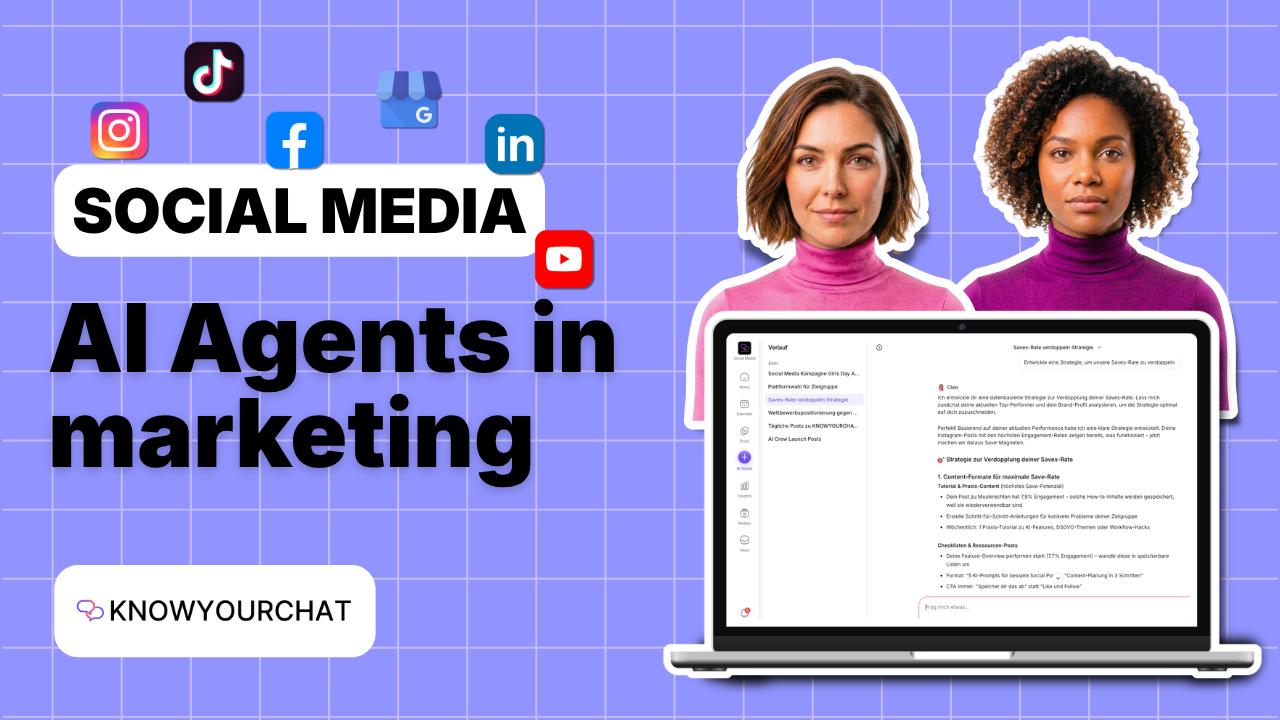
With Cleo, there's an agent at the center who focuses on content development. She helps turn ideas into concrete content, structures posts, and makes sure thoughts aren't just captured but carried forward right away. The process doesn't end with a piece of text — it covers the entire development of a post.
Nova takes on a complementary role in analysis and strategic framing. She works data-driven and helps you understand content in the context of performance, audiences, and development. This creates a connection between what gets created and what actually works.
A decisive advantage lies in the interplay of these agents. Content isn't created in isolation but is created, evaluated, and developed further at the same time. This creates a continuous process that's much closer to how marketing actually works.
Access to this system is deliberately kept low-threshold. Via the star icon, a request can be started from anywhere. The user enters an impulse, and depending on the context, the appropriate agent is activated. Only after sending is this impulse carried into the AI Studio, where the actual development takes place.
The AI Studio forms the central workspace where all content comes together. Here the context is preserved, ideas are carried forward, and content can be supplemented or adjusted at any time. The AI Crew works continuously in the background, making it possible to keep processes going without interruption — regardless of when and where the work happens.
At the same time, the strategic framework stays intact. Via the Strategy Hub, goals, content pillars, and KPIs are defined for the agents to orient themselves around. This creates a clear connection between operational execution and strategic direction.
The strength of this approach also shows in a team context. Content goes through structured approval processes with clearly defined roles. A creator creates content, an editor reviews and approves it. This ensures that quality and speed are guaranteed at the same time.
The forward-looking perspective matters here too: Cleo and Nova are just the beginning. The AI Crew is being continuously expanded, with more specialized agents joining to take on additional tasks and further optimize the workflow.
Conclusion
AI agents aren't a short-lived development but a fundamental shift in how marketing is organized.
Instead of optimizing individual tasks, they make it possible to rethink entire processes. Content no longer emerges in isolation but in context. Decisions are no longer made point by point but within a larger picture.
For companies, that means a clear shift:
Away from tools, toward systems.
In the end, it's not about using AI.
It's about working with it — structured, continuous, and in the right context.
Frequently asked questions about AI agents in marketing
What's the difference between traditional AI and AI agents?
Traditional AI reacts to individual requests, while AI agents understand tasks in context and work on them across multiple steps.
Why are AI agents so relevant right now?
Because context understanding, planning, and integration have advanced simultaneously, making real process support possible for the first time.
What role do AI agents play in social media marketing?
They make it possible to develop content as a connected process instead of as individual posts.